


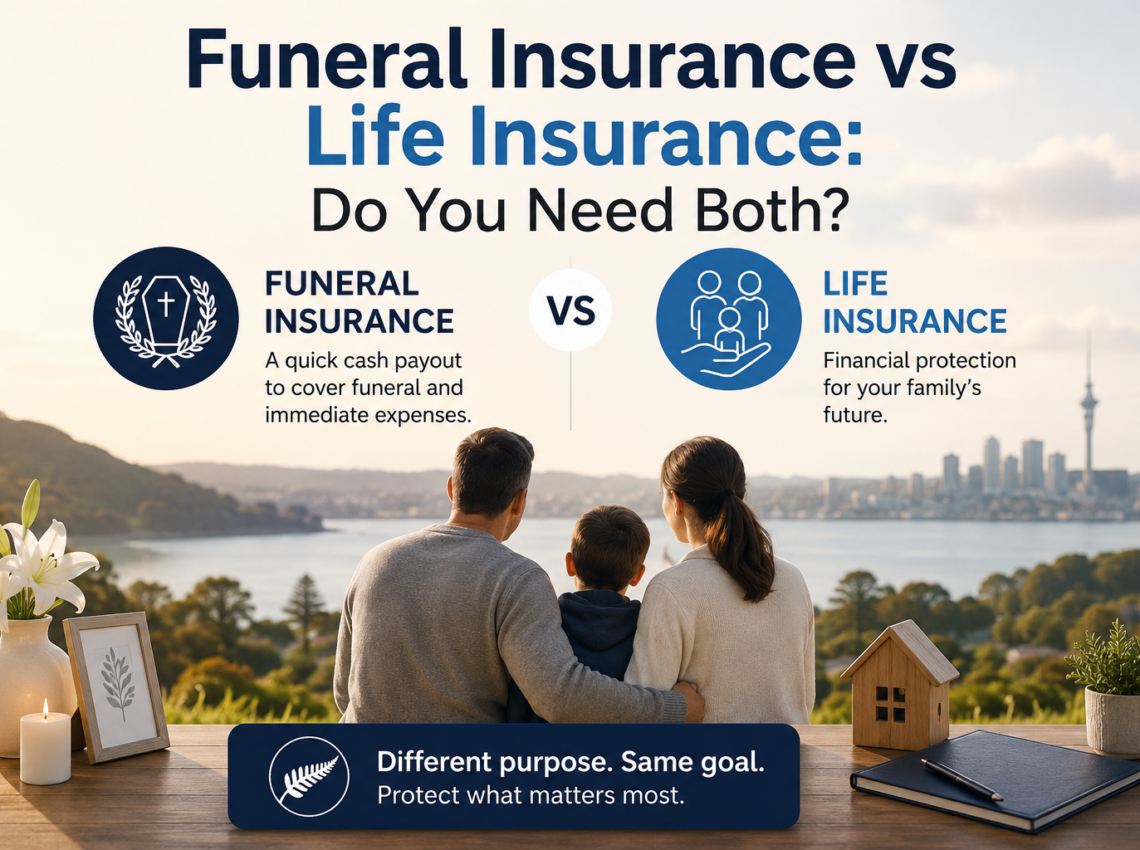
Many Kiwis wonder whether funeral insurance or life insurance is the better way to protect their family — or whether they need both. With average funeral costs in New Zealand now regularly exceeding $10,000–$15,000 (and often higher for attended services or burials), the question is practical, not just theoretical.
Funeral insurance (also called funeral cover or NZ funeral insurance) is designed for one clear purpose: providing a modest, quick cash lump sum to cover funeral and immediate related expenses. Life insurance is broader — it aims to replace income, clear debts, and support dependants over the longer term. Understanding the differences helps you avoid paying for cover you don’t need while making sure your family isn’t left short at a difficult time.
As independent New Zealand insurance advisors, Insurance Helpline NZ works across multiple providers to help people compare options without pressure. Here’s a clear, side-by-side look at funeral insurance vs life insurance so you can decide what fits your situation.
What Funeral Insurance Is Designed to Do
Funeral insurance NZ is a straightforward product. It typically pays a fixed benefit of $3,000–$30,000 (most commonly $10,000–$20,000) directly to your nominated beneficiary when you pass away. The money can be used for funeral director fees, cremation or burial, a service, flowers, catering, travel for family, or any other immediate costs.
Key features that make it accessible include:
- Guaranteed or simplified acceptance for many applicants (often ages 40–75 or up to 80), usually with no health questions asked or medical underwriting.
- Level premiums that do not rise with age on many policies.
- Fast claims — often within a few days once the death certificate is available.
- Immediate cover for accidental death on most policies, with a waiting period (commonly 24 months) for natural causes.
It is sometimes marketed as funeral plans NZ or funeral cover. Because the sum insured is small and the application process is simple, it can suit older New Zealanders or those with health conditions who may not qualify easily for standard life cover.
What Life Insurance Provides
Life insurance pays a much larger lump sum — typically from $100,000 up to several million dollars — to your beneficiaries. The primary purpose is income replacement, mortgage clearance, debt repayment, and ongoing financial support for dependants. Most New Zealand life policies also include a funeral or bereavement advance (often $10,000–$25,000) that can be released quickly to cover immediate funeral costs while the full claim is processed.
Life cover usually requires full medical underwriting. Premiums reflect your age, health, smoking status and the amount of cover. Once the policy is in force there is generally no waiting period for natural causes.
Key Differences at a Glance
| Feature | Funeral Insurance | Life Insurance |
| Typical sum insured | $3,000 – $30,000 | $100,000 – $2,000,000+ |
| Main purpose | Funeral & immediate final expenses | Income replacement, debts, long-term family support |
| Underwriting | Guaranteed / simplified (often no medical) | Full medical underwriting |
| Waiting period | Usually 24 months for natural causes | None once policy is active |
| Payout speed | Very fast (days) | Full claim weeks; funeral advance often days |
| Best suited for | Older ages or health issues limiting options | Working-age people with dependants or debts |
| Cost per dollar of cover | Higher | Generally lower |
These structural differences matter more than marketing claims. A small standalone funeral policy can be more expensive per dollar of cover than a modest life policy that includes a funeral advance.
When Funeral Insurance Makes Sense
Funeral insurance NZ is often the practical choice if:
- You are over 60 and standard life cover is difficult or expensive to obtain because of age or health.
- You have no existing life insurance and simply want to ensure funeral costs do not fall on family.
- You prefer a simple, guaranteed-acceptance product with fixed premiums and a clear, limited purpose.
- You already have substantial savings or other life cover but want a dedicated, fast-access amount ring-fenced for funeral expenses.
For many older Kiwis, a modest funeral cover policy provides peace of mind without the complexity of full underwriting.
When Life Insurance Is Usually the Better Option
For most people under 60 in reasonable health, a life insurance policy (even a relatively small one) frequently delivers better overall value. Reasons include:
- Far more cover for a similar or only modestly higher premium.
- Built-in funeral advance on most major NZ policies, solving the cash-flow timing issue.
- Ability to index cover with inflation so it keeps pace with rising funeral costs over time.
- Broader protection that also addresses mortgage, income replacement and other family needs.
If you already hold life insurance, check whether it includes a funeral or bereavement benefit before adding a separate funeral policy. In many cases the advance already covers typical funeral costs, making extra cover redundant.
Do You Need Both?
Most households need one or the other — not both. Duplication can mean paying twice for overlapping protection.
You might reasonably hold both if:
- Your existing life cover is large but the funeral advance is limited or slow, and you want guaranteed fast cash specifically for the funeral.
- You have complex family or cultural requirements (for example a larger tangihanga) that exceed a standard advance.
- Health or age restrictions mean only a small guaranteed funeral policy is available alongside other cover.
In the majority of situations, an independent review shows that either a well-chosen funeral insurance policy or a life policy with funeral benefit is sufficient. The right answer depends on your age, health, existing cover, family responsibilities and budget.
Practical Steps to Decide
- Check any current life or trauma policies for a funeral/bereavement advance and its amount and speed.
- Estimate realistic funeral costs for your region and preferred style (cremation with service is commonly around $11,700 nationally; burial higher).
- Consider alternatives such as a prepaid funeral plan (locks in today’s prices) or a dedicated savings account if you have the discipline and time.
- Compare actual premiums and features rather than relying on advertising.
- Speak with an independent advisor who can look across multiple NZ providers.
At Insurance Helpline we specialise in helping Kiwis navigate exactly these choices. As independent insurance advisors we compare options from leading New Zealand insurers and explain the trade-offs in plain language. There is no pressure and no obligation.
The Bottom Line
Funeral insurance and life insurance serve different primary purposes. Funeral cover is purpose-built for end-of-life cash needs with simple access. Life insurance provides broader, higher-value protection that usually already includes a funeral component. Most people need one well-chosen policy, not both.
Rising funeral costs in New Zealand make some form of planning sensible, whether through insurance, savings or a prepaid arrangement. The goal is the same: protecting your family from unnecessary financial stress at a difficult time.
Ready to see which option (or combination) fits your situation? Contact Insurance Helpline today for a free, no-obligation review or quote. We’ll look at your existing cover, explain clear options, and help you decide without the hard sell. Call or text 022 159 0696, email paul@insurancehelpline.co.nz, or request a callback on our website — it only takes a few minutes to get clarity.
FAQs
- What is the main difference between funeral insurance and life insurance?
Funeral insurance provides a smaller, fast payout specifically for funeral and immediate expenses. Life insurance pays a larger sum for broader family financial support and usually includes a funeral advance. - Does life insurance already cover funeral costs in New Zealand?
Most major NZ life policies include a bereavement or funeral advance (commonly $10,000–$25,000) that can be paid quickly. Always check your specific policy wording. - Is funeral insurance NZ worth it if I am under 60?
For many people under 60 in good health, a modest life policy with funeral benefit offers better value and more overall protection. Standalone funeral cover is often more suitable for older ages or those with health limitations. - Can I have both funeral cover and life insurance?
Yes, but it is rarely necessary. An independent review can show whether there is genuine overlap or a gap that needs filling. - How quickly does funeral insurance pay out?
Once the required documents (including death certificate) are provided, many claims are paid within a few business days. - What are the alternatives to funeral insurance?
Prepaid funeral plans, a dedicated savings account or trust, increasing existing life cover, or (for eligible low-income families) the limited Work and Income funeral grant.

